Algorithm Variants#
The framework implements several optimizations to the base Quasi-Seldonian
Algorithm (QSA) [Thomas2019] that tighten confidence bounds, leading to improved
solution rates and objective performance. Each variant can be selected via the
seldonian_type argument.
This axis is independent of the confidence inequality: the inequality sets how wide a single interval is, the variant sets how the intervals are combined. Every pairing is accepted.
Mode |
What it changes |
|---|---|
|
Uniform delta/2 splitting at every operator, with the standard Hoeffding bound predicting the safety test. |
|
Decomposes candidate and safety estimation error instead of doubling the safety term, which is tighter whenever the two splits differ in size. |
|
Passes the full delta to the variable subtree when the sibling is a constant, since an exact value needs no interval. |
|
Merges the delta slices of repeated leaves into a single interval by the union bound, so a variable used three times is not paid for three times. |
|
Combines mod, const and bound. |
|
Compiles the constraint to a max of affine forms and bounds each with one interval, exploiting independence across groups. Roughly halves the slack, but only for constraints built from +, -, scaling and abs. |
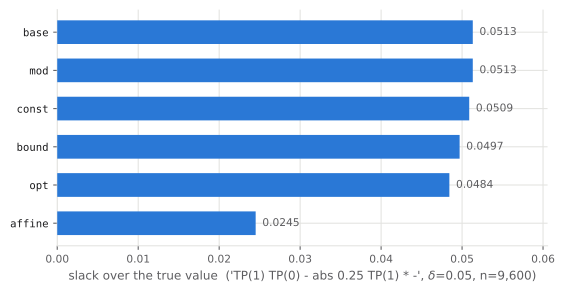
Slack — how far each variant’s bound sits above the true constraint value, on
one model and one dataset. Produced by scripts/make_docs_figures.py.#
Read it as a ranking rather than as absolute numbers, which move with the data. Three things it shows that the table cannot:
The tree optimizations are incremental.
constandboundeach buy a little, andoptabout as much as the two together — a few percent, not a step change.Affine is the step change. It roughly halves the slack, which at a rate is worth about four times the data.
``mod`` looks identical to ``base`` here, and should. It changes the predicted bound that steers candidate selection, not the safety bound being measured. Its effect shows up as a higher solution rate, not a tighter certificate.
The figure is drawn on the default constraint rather than demographic parity
because that one exercises every variant: it repeats TP(1), which is what
bound merges, and carries a literal 0.25, which is what const
exploits. On demographic parity both are no-ops.
Baseline QSA (base)#
The baseline algorithm uses uniform delta splitting and the standard Hoeffding bound [Hoeffding1963] for predicting the safety test outcome during candidate selection.
Predicted confidence interval. During candidate selection, the upper bound on is estimated as:
where and is the candidate ratio.
Here for a two-sided interval and for a one-sided one; the root of a constraint tree needs only its upper endpoint, so leaves that inherit that one-sidedness pay the smaller term. See Concentration Inequalities.
Delta splitting. At each binary operator in the constraint expression tree, is split uniformly:
uv run python scripts/run_paper_experiments.py --out exp/paper --only base
Modified Confidence Interval (mod)#
The baseline doubles the Hoeffding term to account for estimation error in both the candidate estimate and the safety bound. This is conservative: the two sources of error have different sample sizes.
The modified bound decomposes the interval into separate terms:
When does this help? When , the decomposed form yields a tighter interval than doubling the safety-only term. The improvement is most pronounced at extreme candidate ratios.
uv run python scripts/run_paper_experiments.py --out exp/paper --only mod
Constant-Aware Delta Allocation (const)#
In the baseline, delta is split equally at every binary operator node. However,
when one child is a numeric constant (e.g., 0.25), its value is exact — no
confidence interval is needed. The full can therefore be allocated
to the non-constant child.

Comparison of uniform vs. constant-aware delta allocation. When a child node is a constant, the full passes through to the variable subtree.#
Rule. At a binary operator node with :
uv run python scripts/run_paper_experiments.py --out exp/paper --only const
Union Bound Optimization (bound)#
A fairness constraint may reference the same base variable (e.g., TP(1))
multiple times. The baseline treats each occurrence independently, assigning
each its own . By Boole’s inequality (the union bound)
[Bonferroni1936], a single confidence interval with
covers all occurrences
simultaneously.
Example. Suppose TP(1) appears three times in the constraint tree with
allocated deltas , , and . Instead
of computing three separate intervals, a single interval is computed with:
This yields a wider effective and hence a tighter confidence interval for each occurrence, since for each .
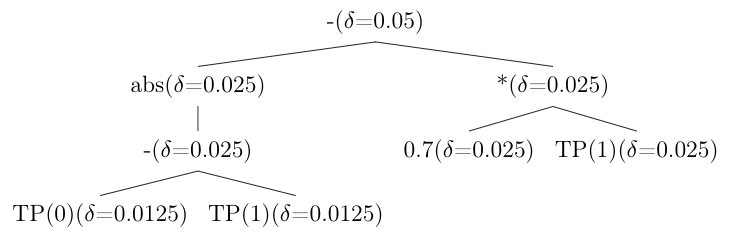
Without union bound optimization: each occurrence of the same variable uses a separate, smaller .#
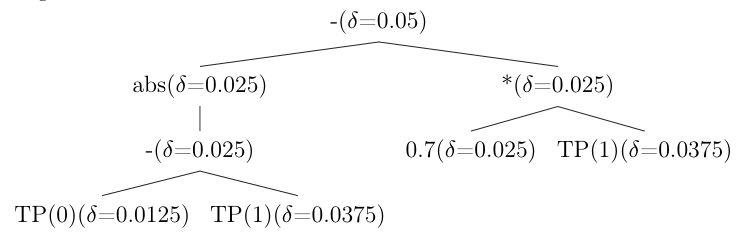
With union bound optimization: all occurrences share a combined , yielding tighter bounds.#
uv run python scripts/run_paper_experiments.py --out exp/paper --only bound
All Optimizations (opt)#
Combines the modified confidence interval (Modified Confidence Interval (mod)), constant-aware delta allocation (Constant-Aware Delta Allocation (const)), and union bound optimization (Union Bound Optimization (bound)) for the tightest bounds.
uv run python scripts/run_paper_experiments.py --out exp/paper --only opt
Affine-Form Compilation (affine)#
The variants above all keep the same underlying strategy: wrap a confidence interval around every node of the constraint tree and combine them with interval arithmetic. That is sound but loose for two compounding reasons. Interval arithmetic assumes the worst about how sub-expressions relate, even when they are means over disjoint groups and therefore independent; and every leaf occurrence spends its own slice of .
For constraints built only from +, -, scaling by a constant and abs
— which covers the standard gap-based fairness definitions — neither cost is
necessary. Such an expression can be rewritten exactly as a maximum of finitely
many affine forms in the base variables:
Why one interval per form suffices. All cells of a single group are means over the same rows, so for group the partial sum is itself the mean over that group’s samples of the scalar . Distinct groups are disjoint, so conditional on the group counts their means are independent and Hoeffding applies to the weighted sum directly:
with the a-priori range of within group . Only slices of are spent — one per form — instead of one per leaf occurrence.
Worked example. The constraint |TP(0) - TP(1)| - 0.2 TP(1) <= 0 compiles
to max(TP(0) - 1.2 TP(1), -TP(0) + 0.8 TP(1)): two forms rather than three
leaf intervals. Measured slack over the true value falls by 50.0% across sample
sizes from 10k to 160k and several parameter vectors. The ratio barely moves,
because the saving comes from the delta split and the independence of the groups
rather than from the data. Since a Hoeffding half-width scales as
, halving it is worth roughly 4x the data.
Limits. Anything outside that fragment raises
NotAffine. Division is the usual
cause, so the practical rule is to reach for a rate primitive rather than
writing the ratio out. TPR(1) TPR(0) - abs 0.1 - compiles; the equivalent
TP(1) TP(1) FN(1) + / ... does not, because a quotient of two variables
cannot be rewritten as a max of affine forms.
Every builder shipped in fair_seldonian.constraints.fairness is written
this way and therefore compiles — see the Affine forms column of the generated
table in Fairness constraints, which is produced by running the compiler
over each one.
Note
Every inequality works with affine: the per-form interval is built by the
same code as any other leaf interval, just applied to the weighted sum. Do not
assume the per-leaf ranking carries over, though — the widths depend on the
range of the weighted variable, not of a single cell, so the tightest
inequality for a leaf is not always the tightest for a form.
uv run python scripts/run_paper_experiments.py --out exp/paper --only affine
See fair_seldonian.constraints.affine for the compiler itself.